

EU-Funded ROOTS Project Strengthens Women Farmers Against Climate Change
By Ahmad Tijjani Abdul
KANO – Dozens of women smallholder farmers, including returnees and internally displaced persons (IDPs), are being equipped with climate-smart agricultural skills in Kano State under the European Union–funded Resilient Opportunities for Outreach, Trade and Sustainability (ROOTS) project.
The project, implemented by the Adolescent Health and Information Projects (AHIP) in partnership with the International Organization for Migration (IOM), aims to strengthen household food security and improve the livelihoods of women farmers through sustainable urban and peri-urban farming practices.
The ROOTS project is implemented by AHIP in partnership with IOM, with support from the European Union and the Free Movement of Persons and Migration in West Africa Phase II (FM West Africa II) Programme.
ROOTS Programme Officer, Halima Kasim Usman, said the project targets women smallholder farmers among returnees and IDPs in Ungogo, Dala and Bunkure Local Government Areas.
She explained that Bunkure was selected due to the high number of smallholder farmers and that AHIP partnered with the Centre for Dryland Agriculture, BUK, to train women in climate-smart agriculture from nursery to harvest.
Halima Kasim Usman added that the project also seeks to empower women economically by encouraging cooperative formation, income generation and improved household food security.
On his part, Professor Aminu Alhassan Fagge of the Centre for Dryland Agriculture, BUK, said the second phase of the project concentrated on climate change and agriculture, demonstrating how crops could be successfully cultivated in backyards and sacks despite environmental challenges. He urged greater support for female farmers.
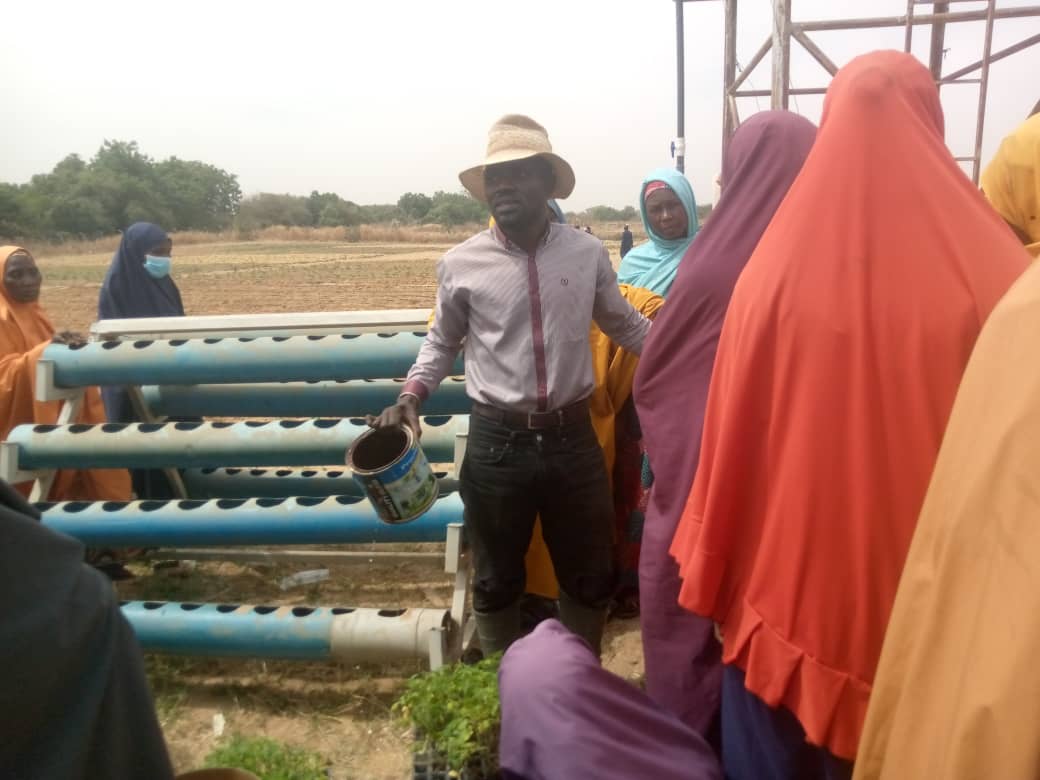
The training comprised theoretical and practical sessions. While classroom lectures were held at the AHIP Human Development Institute, the practical component took place at the Centre for Dryland Agriculture, Bayero University Kano (BUK).
Participants were trained in modern farming techniques, including nursery establishment, transplanting and harvesting, with emphasis on backyard and sack farming suited to limited spaces.
Fatima Sani, a participant from Bunkure Local Government Area, said the programme exposed participants to modern agricultural practices that enable food production within small spaces.
Another participant, Rabi Lawan from Hotoro in Tarauni Local Government Area, said the training covered manure application, sack planting, irrigation using pipes, farm sanitation, rice cultivation and the use of neem seeds as organic pesticides.
The programme also focused on the effects of climate change on crop production and strategies for cultivating crops under changing climatic conditions.